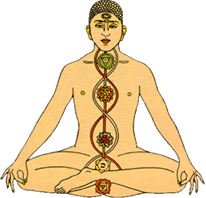
Nadi is a Sanskrit word which may be translated as “tube”, “pipe”, “channel”, or “flow”. The Nadis are the channels through which the energies of the subtle body flows, the life force energy known as “Prana”. They are closely associated with the nervous system, stemming from and intertwining with the chackras.

Ayurveda mentions seventy-two thousand Nadis. Tantra Yoga identifies 14 principle nerves, each relating to the traditional organs of the body.

Three of these are considered the most important and are as follows:

- IDA NADI: Ida is a Sanskrit word which means “comfort”. It starts and ends to the left of the Susumna, terminating in the left nostril, but is also connected to the left testicle in males. Ida Nadi is feminine energy with a cooling effect. It is introverted and is associated with the right side of the brain and the left side of the body. It is also called “chandra” or “moon” Nadi since it is associated with lunar energy.  Ida Nadi controls all of the mental processes. It carries pranic energy and nourishes and purifies the body and the mind.

                                                                                                    
- PINGALA NADI: Pingala is a Sanskrit word which means “tawny”. It starts and ends to the right of Susumna and courses from the right testicle in males and culminates in the right nostril. Pingala Nadi is masculine energy and has heating temperature, adding vitality, physical strength and efficiency. It governs the right side of the body and the left side of the brain. It is also called “suria” or “sun” nadi since it is related to solar energy. It controls all of the vital processes. Pingala is extroverted.

SUSUMNA NADI: This is the central nerve (spinal cord) and means “penetrating conduit”. It is “Sattva”, the rhythm beyond duality. Susumna connects the base chakra to the crown chakra.

The movement of Susumna indicates the flow of “Prana” (vital air) through Ida and Pingala down the base of the spine where Kundalini lies coiled.

Shakti Kundalini will then awaken and rise up Susumna, energizing the seven chakras.
From Muladhara chakra, Ida and Pingala alternate at each chakra until they reach Ajna chakra where they meet again with Sushumna.

In Ajna chakra, the meeting of the three main nadis is called Mukta Triveni (Mukta : "liberated"). Continuing beyond Ajna chakra, Ida and Pingala end in the left and right nostrils respectively.

Once the Kundalini Shakti has ascended through Sushumna to Sahasrara, the highest psychic center at the crown of the head, it reverses its course and returns to rest in the base center again.

Susumnadi generally remains dormant when the other Nadis flow strongly and is activated only when the breath comes through both nostrils simultaneously. It operates automatically at dawn and dusk, calming the system and facilitating meditation.
It is said that when Susumna becomes active, the yogi becomes invisible to the world. It is then that the yogi's real work begins.

Ida and Pingala Nadis are stimulated through different practices, including Pranayama, which involves alternate breathing through the left and right nostrils, thus stimulating the left and right sides of the brain respectively. These Nadis are also said to have an extrasensory function, playing a part in empathic and instinctive responses. They are also closely associated with the left and right sympathetic cord, which is associated with growth and heating the system.

Ida and Pingala indicate time, the past and the future respectively. Susumna is the destroyer of time. It is the present moment and it is timeless.

These three nerves are directly related to the three “Gunas”, or the qualities that are manifested in every part of the physical world: “Tamas”, meaning inertia; “Rajas”, meaning activity; and “Sattva”, meaning rhythm. Everyone manifests the first two Gunas to some extent. The development of Sattva, also defined as tranquility, requires balancing the “Rajas” and “Tamas” into one.

 I'm not sure what this is referring to, the energies of the subtle body? the channels? the Nadis?

 Should this be chakras?


Ask us a question about yoga!
First Name
Last Name
Email
Comments  


TheSecretsOfYoga.com - Everything you want to know about yoga!
Copyright 2008, TheSecretsOfYoga.com. All rights reserved | Disclaimer | Sitemap