
 Today there is a growing urge to find ones’ the true self. For some reason we feel the need to turn knowledge into wisdom and also to know the eternally infinite. It is against this backdrop of aspiration and modern thought that the contributions of the Upanishads have become so significant.
The purpose of the Vedas was to ensure the worldly and spiritual welfare of all beings. Before achieving this synthesis, there is a need to penetrate the inner worlds. The Upanishads do this through the science of self, which leaves behind the ego and other non-self perishable elements. The Upanishads tell a grand saga of the divine heart of man. The Upanishad’s sages were concerned with individuals beyond the political or social dimension. Their inquiry challenges concepts of life and death, delving into the immortal, divine self.
The Upanishads, as part of the Vedas, form the core of Indian philosophy. They may be described as “the supreme work of the Indian mind.” A salient characteristic is their universality and lack of dogma.
The Upanishads are a timeless fountain of spiritual knowledge. Focusing on philosophy, meditation, and the nature of God, they contemplate the Vedas’ essence. The Upanishads are known as Vedanta (culmination of the Vedas).
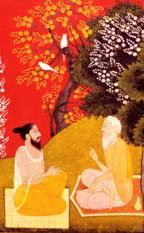
‘Upanishad’ means inner or mystical teaching. The term derives from upa (near), ni (down) and s(h)ad (sitting), that is, “to sit close by.” It means sitting in rapt attention while listening to the doctrines of a guru or spiritual teacher. These are the ones who recognize fundamental and universal truths. Pupils learn secrets within the quietude of a forest ashram, or hermitage, where Upanishad thinkers ponder deeply and pass knowledge along.
Upanishad also implies Brahma-knowledge, wherein ignorance is shattered. Originally transmitted orally, this collection contains the fundamental Hindu teachings, karma (action), punarjanma (reincarnation), moksha (nirvana), atman (the soul), and the Absolute Brahman.
They also encompass the prime Vedic doctrines of self-realization; Yoga, meditation, and reincarnation that had been symbolically hidden within the older religions. The Upanishads also contain the first reference to the sacred word Om, the cosmic vibration underlying all existence that subsumes everything within the One Self. The chant Om Shanti Shanti Shanti, first found in the Upanishads, calls for tranquility, divine stillness, and everlasting peace.
The Upanishads belong to no definitive period of Sanskrit literature. The older texts were fixed to a particular Veda, through a Brahmana or Aranyaka, before 7th century B.C., and even before the Bhavagad Gita. The most recent texts not related to any particular Veda were probably composed during the medieval or early modern periods. The Upanishads became widespread centuries before Krishna and Buddha.
The philosopher Shankara (circa 8th century) composed 11 Upanishad commentaries. These mukhya Upanishads are counted among the oldest, spanning the late Vedic and Mauryan periods. By the 1600s, their numbers had grown: the Muktika Upanishad (pre-1656) lists 108. Dara Shikoh (d. 1659) translated 50 Upanishads into Farsi. Other counts give a total of 108, 200 and sometimes even 300!
The Upanishad authors were not only priests; some were poets, prone to flashes of spiritual wisdom, aiming to guide others to the point of liberation that they had achieved.
Scholars think the shadowy main figure of the Upanishads is that of sage Yajnavalkya. This is because later teachings of Hindu and Buddhist philosophy derive from him. He taught neti-neti, the view that truth is found only through its negation. Other Upanishad sages include Uddalaka Aruni, Shwetaketu, Shandilya, Aitareya, Pippalada and Sanat Kumara. Early Vedic teachers like Manu, Brihaspati, Ayasya and Narada.
Principal Upanishads
Those commented on by Sankara have acquired extra significance as the canonical Upanishads, Shruti to Hindis. They are listed by association–Rigveda Veda (RV), Samaveda (SV), White Yajurveda (SYV), Black Yajurveda (KYV) and Atharvaveda (AV)as follows:
Chandogya Upanishad (SV)
Actually the last eight chapters of the ten-chapter Chandogya Brahmana that emphasize chanting the sacred Om, and recommend an austere, charitable religious life spent contemplating the Vedas. It suggests this is best done by dwelling with a guru. It also says that the doctrine of reincarnation is an ethical consequence of karma, and attempts to explain the valuable attributes of speech, will, thought, meditation, understanding, memory, and hope.
Kena Upanishad (SV)
Derivation of Kena, meaning ‘by whom’. This Upanishad contains four sections, two in verse, two in prose. The primary metrical portion deals with the Supreme Unqualified Brahman, the absolute principle underlying all phenomenon; the prose deals with Isvara, God Supreme. It observes that austerity, restraint and work are the core beliefs. Enlightened people know this Upinshad for striking down evil, and in establishing a most excellent, infinite, and heavenly world.
Aitareya Upanishad (RV)
This Upanishad leads the mind from outer ceremony to inner meaning. It deals with the beginnings of the universe, and the creation of life. It fathoms the intelligence that allows speech, hearing, knowing.
Katha Upanishad (KYV)
Consisting of two chapters of three sections each, Katha Upanishan recounts an ancient Rig Veda story about a father who brings death to his son to explain the teachings of spirituality. Some passages are common to both the Katha Upanishad and the Bhagavad Gita. An analogy of a chariot helps us to understand this better. The soul is the lord of that chariot, and the body; intuition is the chariot-driver; the mind, the reins; and the senses become the horses. Sensed objects are but pathways. Undisciplined minds will not reach their goals, but instead continue t reincarnate eternally. The wise and disciplined, it is said, will reach theirs, and become freed from the cycle of endless rebirth.
Mundaka Upanishad (AV)
The Mundaka Upanishad has three chapters and consisting of two sections. Mundaka derives from the root mund (to shave), because those who comprehend are “shaved” liberated from dull ignorance. It postulates that the distinction between high knowledge of the Supreme Brahman and low knowledge of the empirical world is contained within the six Vedanga: phonetics, ritual, grammar, definition, metrics and astrology. It is by this wisdom, and not the ‘unsafe boats’ of sacrifice or worship, that one reaches the Brahman. This Upanishad warns against “the ignorance of learned thinking,” and of maintaining blind delusions. Only an ascetic sanyasi who retains nothing will gain all.
Taittiriya Upanishad (KYV)
This Upanishad is divided into three sections. The first deals with the science of phonetics and pronunciation, the second and third with knowledge of the Supreme Self, Paramatmajnana. Om is again emphasized as the ultimate peace for the soul, and prayers end with shanti chanted thrice. These are often preceded with May we never hate. There is debate regarding the importance of seeking truth, practicing austerity, and studying the Vedas. One teacher holds that truth comes first, another says it is austerity, and a third claims that it is teaching the Vedas, because they include austerity and discipline. This Upanishad says that the highest goal is to know the Brahman, for that is the truth.
Brihadaranyaka Upanishad (SYV)
This is generally thought to be the most important Upanishad, and consists of three Kandas, sections: the Madhu Kanda, which explores individual identity. The Universal Self; the Muni Kanda that provides philosophical underpinnings; and the Khila Kanda, which deals with worship, meditation and contemplative reflection.
Svetasvatara Upanishad (KYV)
The name derives from the sage who disseminated its teachings. Theistic, it identifies the Supreme Brahman with Shiva, lord of the world. The emphasis is not on Brahman the Absolute, whose perfection does not admit of evolution, but on the omniscient and omnipotent manifested in Brahma. This Upanishad explains the unity of soul and world in one Supreme Reality, and reconciles the different philosophical and religious views prevalent during its writing.
Isavasya Upanishad (SYV)
This Upanishad is named for its opening word Isavasya, meaning ‘Lord that encompasses all’. This short and reverential Upanishad is often given primacy, and marks the trend toward monotheism. It essentially teaches the unity of God, the world, of being and becoming. Not so much interested in the Absolute, Parabrahman, but in the Absolute’s relation to the world, Paramesvara, it holds that renunciation of the world, and not coveting the possessions of others, brings joy. It concludes with a prayer to Surya and Agni, sun and fire, respectively.
Prasna Upanishad (AV)
Prasna has six sections dealing with the six questions, or Prashna, put to a sage by his disciples: From where are all creatures born?; How many angels illuminate a creature, and which is supreme?; What is the relationship between the soul and breath?; What is meant by sleep, waking and dreams?; What is the result of meditating on the Om?; and, What are the sixteen parts of Spirit? This Upanishad attempts to answer these vital questions.
Mandukya Upanishad (AV)
The Mandukya Upanishad explains Om as consisting of the three elements a, u and m, used in experiencing the soul. Twelve verses delineate the four levels of consciousness: waking, dreaming, deep sleep, and a mystical state of being. This Upanishad alone is thought to be enough to lead to liberation. These last two are the oldest Upanishads remaining from the Vedic transition into Sanskrit:
Maitrayani Upanishad
The last of the principal Upanishads, Maitrayani recommends meditating upon the soul (atman) and life (prana). It envisions the body as an empty chariot driven by a being of intelligence, pure, selfless and endless. The charioteer, of course, is the mind, the reins the five organs of perception, the horses represent action, and the soul is unmanifested, incomprehensible and steadfast. It relates the story of king Brihadratha who, realizing his body was not eternal, withdrew to the forest to seek austerity and liberation from reincarnating existence.
Kaushitaki Upanishad
Examines if reincarnation is endless, and upholds the supremacy of the soul.
Earlier passages of texts like the Brahmanas and Vedas are also often considered Upanishads.
The Muslim Sufi Dara Shikoh, son of Mogul emperor Shah Jahan, translated the Upanishads into Persian in order to find monotheistic elements and a bond between Islam and Hinduism.
The Upanishads explore and explain the basic Hindu beliefs of a world soul, a universal spirit, Brahman, and the individual atman soul.
The Upanishad sages sought reality beyond knowing; they sought to unravel the riddles Who is the knower? ; What causes thinking?; Is life purposeful or mere chance?; and, What caused the cosmos?
The Upanishads were transmuted into the true Vedas by philosophers whose various interpretations generated the six orthodox Shad-Dharshanas, or Vedanta schools of Hindu thought: Nyaaya, Vaisheshika, Saankhya, Yoga, Puurva-Meemaamsa and Utthara Meemaamsa.
The Uttara Meemaamsa, a major representational doctrine, contains knowledge based on the Vedic tradition and other assimilated Hindi philosophies. This particular school of thought, and the Patanjali Yoga, are the most adapted to Brahman orthodoxy.
This link contains a full translation of the Upanishads:
http://hinduism.about.com/library/weekly/extra/bl-maxupanishads.htm
And this link lists books about them:
http://www.amazon.com/s/ref=nb_ss_b/103-3663341-2898206?url=search-alias%3Dstripbooks&field-keywords=upanishads