
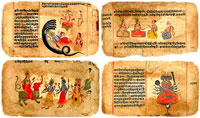
 Strictly speaking, the way Hinduism is designed cannot be considered a religion. However, it can be catalogued as a complex social/cultural institution composed of many philosophical sects including rituals, spiritual ceremonies, disciplines, and numerous deities.
Hindu spirituality is based on the VedasBooks of Knowledge. Written in Sanskrit, the sacred language of India, these texts delegate a religious authority for much of Hinduism.
‘Veda’ means truth Sanskrit.
Vedic texts are usually dated between 1500-500 B.C. They may be the oldest sacred texts in existance. Handed down orally for centuries, portions were preserved by trusted families. To this day, some texts bear the name of their protectors.
Hindu mythology accredits Krishna, here called Vyasa, as scribe to the Vedas and buttressing texts. A number of Vaishnava traditions regard him as Vishnu’s avatar. The name ‘Vyasa’ means Compiler of the Vedas.
Vyasa simplified the Vedas (Yajur) into the following four chapters to expedite their diffusion among the people:
- The Samhitas
- The Brahmanas
- The Aranyakas
- The Upanishads
He used this knowledge to forecast the era of Kali, an evil genius who appeared at the same instant Krishna vanished. In Hindu chronology, the era of Kali which began on February 18, 3102 B>C., will last 432,000 years.
SAMHITAS (In Sanskrit collection); this grouping of metric texts, or mantras, contains four Vedic Samhitas:
1- Rig Veda (Verse Veda, or stanza of praise) is the oldest significant Indian text. It is comprised of a collection of 1200 epics composed to Indra, god of storms, and Agn, god of fire. In antiquity, Indradey was an important deity.
These poems where composed over some 500 years. Based on accepted opinion, the oldest date from 1500 B.C., when Aryans settled the Punjab frontier prior to entering the Ganges Valley.
The Rig Veda is not as precise as the Yajur Veda, nor as characteristic of divine praise, nor written so sublimely.
2- Yajur Veda (the Veda of sacrificial formula) means to sacrifice in prescribed steps. It contains archaic asterisms, prose mantras, sacerdotal ceremonies and rites. There are two primary versions, or samhitas: the Shukla (white) and Krishna (Black). Both contain verse rituals, but the Krishna Yajurveda includes Brahman prose commentary, which the Shukla Yajurveda considers as separate texts.
3- Sama Veda (the Veda of Chants, or Knowledge Melodies) with 1,549 stanzas was designed for Tala rhythms and Raga melodies. Taken from the Rig-Veda except for some 78 stanzas (which are repeated). The hymns were sung according to fixed melodies, hence the collection’s name.
4- Atharva Veda (Knowledge of Atharvas, or Priest of Fire) contains spells and exorcisms, a mixed bag of enchantments. These ensorcellments were as much to bless as to curse. They contain amulets to ward off demons, wizards, disease and oppressors of Brahman. Its beneficial potions assure love, domestic bliss, health, longevity, safe travels, and luck while gaming.
It is believed that reciting this Veda promotes long life, cures disease, and ensures the ruination of one’s enemies. Many verses have been taken unmodified directly from the Rig Veda. The Atharva Veda Samhita contains 760 hymns, 160 of which are also found in the Rig Veda. Most verses are metrical, although some are in prose.
The Atharvana Veda is preserved in the Paippalada and Saunaka recessions. Paippalada is the longer of the two; Saunaka remains only partially printed, and untranslated.
The four parts of the Vedas were entrusted to wisemen: Paila Rsi taught the Rig Veda, Jaimini was professor of the Sama Veda, Vaisampayana was given the Yajur Veda, and Angir (Sumantu Muni) took possession of the Atharva Veda. These sages distributed this knowledge among students, who disseminated it among their students, and thus was born the different branches of the Vedic tradition. Four different schools, the Sacas, came of it.
BRAHMANAS: consist of vidhi and artha-vada, or detailed explanations on conducting ceremonies and explaining legends. Each Brahmana is associated with a particular Samhita or its recession. They’re also dedicated to Brahman rituals and mantras. The Vedas are books of revelation; the rest are considered elaborations of the Brahmans, which may include the Aranyakas and Upanishads
ARANYAKAS: (Wilderness Texts) conclude the Brahmanas with interpretations of dangerous rituals, and like material.
UPANISHADS: are philosophical works in dialog form that attempt to explain reality. They are usually found in the Brahman section. ‘Upanishad’ means to seat with devotion; or secret education. It contains the knowledge of Brahman, who destroys ignorance and moves toward liberation. Although many have been lost, there are over 100 available in prose, verse, or both.
Upanishads explain the nature of God, and the relation between the soul and matter. They are the Vedanta, literally, the end of the Vedas.
The Upanishads transmuted into the Vedas through interpretation by the Hindu philosophers. This spawned the six orthodox Shad-Dharshana schools that remain the end and essence of Hindi thought: Nyaaya, Vaisheshika, Saankhya, Yoga, Puurva-Meemaamsa and Utthara Meemaamsa.
They explain the events of the past, present, and future. They teach the avoidance of suffering, anxiety and pain, and of taking responsibility for one’s enlightenment.
The Uttara Meemaamsa, or Vedanta, is a major representational doctrine based on the Vedic tradition and assimilated philosophies. This and the Patanjali Yoga are best adapted to Brahman orthodoxy.
The four groups of Amnia texts (meaning to learn by repetition and reflection) handed down from antiquity include Shruti (in Sanskrit ‘Sruti’, to be heard), meaning that learned knowledge should be revealed, received and transmitted.
The rest of Vedic literature, like the Puranas and the Itihasas (Mahabharata/Ramayana histories), contain explanations by the scribe Vyasa to help in comprehending the Vedas. They are also called Veda-matha (Mother Veda, inheritor of spiritual treasure) that reveal life’s intent and the path to self-realization.
A number of added works exert a greater influence than the original Vedas:
– Vedangas (literally, limbs of the Veda), are the “appendages” (angas) of the Vedic body. Six technical subjects related to the Vedas are phonetics, meter, grammar, etymology, astronomy and ritual.
– Aranyakas (to be learned) knowledge given over to contemplative penitence in a forest arania.
– Upavedas (secondary knowledge), unrelated to the Vedas, are texts composed by rishis to apply Vedic knowledge. Four are usually mentioned: Medicine (Ayurveda), associated with the Rigveda; Archery (Dhanurveda), associated with the Yajurveda; Music and sacred dance (Gandharvaveda), associated with the Samaveda; and Warfare (Shastrashastra), associated with the Atharvaveda.
In the 6th century BCE a schism arose over Jainism and Buddhism, though both discussed lessons of the Vedas. The remaining texts of Sanatana Dharma, Eternal Law, adapted reconstituted concepts that corresponded to the changing times. Even today, the Vedas continue to heavily influence Hindus. In time, some of the less popular Gods were abandoned and many mantras, songs, praises, traditions and rites were modified, though never the essential beliefs.
According to the Vedas, individuals must come to understand their relation with God, and God’s true identity. This happens when one accepts the impermanance of the body, and the fact that Spirit and the Soul live forever.
The Vedas make clear one’s relationship with Shiva. And this conscienceness pervades not just the Vedas, but all life’s important activities: art, music, literatureeven cooking and eating.
Here is a link to understanding the Vedas:
And a list of Vedas books
This is an online book:
and this link has many Vedic translations and Sanskrit texts.
Four Vedas in original Sanskrit