

This program is not one which you will find in a quick meditation guide; it has been studied and thoroughly experimented with throughout long periods of time.
If you really want to obtain the highest state of meditation, you should commit yourself to following through with your practice. Many people fail after trying only a few times. However, the ones who persevere with their meditating will achieve a higher state of being.
The process is very simple. Let’s begin!

The goal for the two first months are:
- To learn how to sit every day at the same time (make it a habit).
- To develop a good sitting posture.
We previously described the different sitting positions and it very important that you choose one. Easy Pose is reccommended, however, you may decide you are more comfortable in a different one. During the first month of medidtation you may choose to sit against a wall for support. Although this may seem easier, you will soon have to learn how to sit independently without any support.
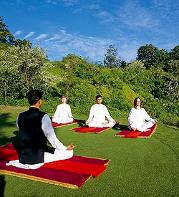
As mentioned before, the surface that you practice on should not be too soft, too firm, or too high. A good meditation surface could be a wooden plank and a couple of blankets folded into quarters.
Keeping yourself in a steady position means that you must keep the spine in perfect alignment with the neck. In the beginning you will encounter different challenges such as numbness of the extremities, perspiration, shakes, twitching in the eyes and also dry throat or excess of saliva in the mouth (which are both signs of improper nutrition). If you experience a dry throat you may want to get a sip of water.

Don’t try to sit for too long. Start with fifteen to twenty minutes. Every three days you can increase your time by three minutes. You want to go slowly and progressively so it will be a pleasant experience and thus you will look forward to meditating again the next day.
Once you are sitting down do a mental check from head to toes:
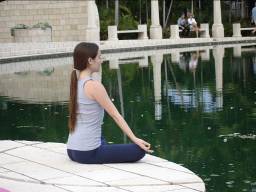
- No tension in the forehead.
- The eyes should be closed. To help focus the mind most people use the dristhi. Dristhi are specific points in the body. When the eyes are directed towards dristhi will help you to focus the mind. Some of these points are the third eye, tip of the nose, top of the head, and so on. The eyes can be directed to the dristhi, however, do not do this with too much intensity because you could develop a headache. You can direct the eyes in a gentle way and some meditations even have a specific given dristhi.
- The lips should be sealed. The teeth are touching (gently). No tension in the jaw.
- No tension in the neck.
- No tension in the shoulders.
- No tension in the arms and fingers. The hands are placed on the knees, or as close to the knees as the length of your arms allows you to bring them without bending the spine.
- No tension in the chest.
- No tension in the pelvic area.
- No tension in the legs, knees, and feet.
- Start over again from the toes to the head.
- Take ten long deep breaths in and out while you allow the body to relax deeply. If you feel there is still a point of tension, mentally ask your body to let it go. The mind has the ability to heal the body.
Getting to know the mind
It is through the senses that we perceive the world. The conscious mind relies on ten senses to obtain information. Five of those are cognitive senses that include sight, hearing, taste, smell, and touch. The other five are active senses and include the hands, feet, power of speech, organs of reproduction, and elimination. The mind stores impressions in the unconscious and reuses them when needed.
All sadhanas have the same goal, which is to train the mind. Once your mind is a single, pointed focus, you become aware of the immortal soul beyond the mind.
Through the daily practice, or sadhana, we can discipline and clear our minds. A clear mind is capable of conscious healing and the prevention of disease. Never doubt this!
Sadhanas also allow you to accurately perceive and assess the exterior world, to clearly collect data as it is.
There are 4 functions of the mind:
MANAS: These lower interaction of the mind with the outside world. They also take sensory impressions, data, doubts and questions. (If this tendency is prominent it may cause problems.)
BUDDHI: This mean a higher inner mind and the ability to make wise decisions, judgments, and cognitive discriminations. It also deciphers the wiser action between two courses of actions if MANAS accept its guidance.
AHAMKARA: This is the individual ego and provides a sense of identity along with feelings of separation.
CHITTA: This is our memory bank. Chitta stores experiences and impressions.
Through meditation we start to be conscious of the different functions of the mind. We can observe our very own minds and watch them through our actions and speech.
Once you are able to meditate in a perfect and still meditative pose, you can start to pay attention to the breath. The body must not shake, jerk, or squirm because this hurts meditation. The breath should be comfortable and full. You want to take care of the four most common problems with the breath which are jerkiness, shallowness, noise, and extended pauses.

After doing your Yoga asanas and breathing exercises, deeply relax the muscles, the subtle muscles, and the nervous system.
Alternate breathing can be beneficial, but during meditation you are only going to practice “breath awareness”. There is a fine relationship between the mind and the breath, which is why we focus on the breath.
- Sit in a cross-legged position.
- Inhale through the base of the spine to the crown of the head, and exhale from the crown of the head to the base of the spine. It can be very helpful to visualize the three nadis in the spine: ida, pingala, and the central channel sushumna. Inhale and exhale through the central channel ( a milky white tube). Feel the energy as it goes up and down through the spine from the pelvic plexus to the medulla oblongata.
- Observe how many times the mind gets distracted. The distraction is always followed by an irregularity in the breath.
- When breathing, focus your attention on the breath as it goes in and out. You will notice that one nostril is more open than the other. This is normal and it can be changed by paying attention to the closed nostril for just a few moments. It will also give you control over the flow of breath. Breathing through the right side brings a warming effect and breathing through the left side brings a cooling effect. Depending on what side is in charge, disturbances in the mind can occur making it important that we gain control over disturbances of the tattvas.

- AWAKENING SUSHUMNA. By focusing the attention in between the two nostrils, you can make both nostrils flow equally. This does not mean that you direct the eyes to the tip of the nose. The focus should always be on the awareness of the breath just above the upper lip, which is the union between ida and pingala. This state where there are no fears or negative thoughts can help to distract the mind and is truly amazing. Unfortunately it doesn’t last long. Although, if you practice regularly in the morning and evening it can be easy to obtain.
- Once you can hold this state for five minutes you have overcome a major obstacle. You have now developed a one-pointed mind. Keep practicing this for three to four more months.
- The point now is to witness your own thought process and also be able to remain undisturbed by different mental scenes, emotions, memories, and concepts. This seems unthinkable to most people! Practice this for three to four months.

There are different levels of the mind and the unknown unconscious mind is one of them. This is where impressions of our actions, desires, and emotions are stored. This level of the mind corresponds with the deepest level of the mind. It is still a mystery and one single memory can create a disturbance. Be patient. Contemplate and analyze your fears. You will gradually be able to inspect your thinking without disturbing the mind. This state is called Samadhi. There are four stages of Samadhi and when you can focus the mind for just ten minutes without disturbance, you have come close to achieving this state. The final step is to be silent. This silence is regarded as indescribable, the opening of intuitive knowledge of all times. From silence comes happiness, bliss, and peace.
Meditation Table of Contents
- General Overview
- Sitting Positions
- Yoga Positions
- Best Places to Meditate
- Best Time to Meditate
- How Eating, Sex and Sleep Affect Your Meditation
- Breath Control or Pranayama
- Nadis
- Basic Procedures for Alternate Nostril Breathing
- A Specific Program to Get You Started
- Time and Effects During Meditation
- How many days should I do this Meditation for?
- Benefits
- Tips for a Meditative Mental State
- Different Types of Meditation
- Frequent Questions and Answers