
Drishti
 Drishti literally means ” perception“. Drishti is the specific point at which to look or focus the gaze when practicing yoga. Looking at the Drishti focuses the mind and brings the concentration inwards.
When we meditate we lock our optical nerve. When we
lock the optical nerve the whole head is locked, your mind stops varying.
The Drishtis that lock the optical nerve are: brow point, tip of the nose, chin.
The eyes close while looking at the chin and then the eyes are 9/10 closed looking to the tip
of the nose; this is the safest of all.
When this happens, mind, body and soul are in line. Through physical control, the subconscious mind releases all kind of thoughts. When you have a negative thought it goes horizontal, and when you chant a mantra it goes up, changing negative into positive. That’ s how you consume your subconscious mind, and when the subconscious mind is empty, the conscious mind is clear and you don’t have nightmares. — Yogi Bhajan
Our goal when practicing Yoga is to look inside of ourselves, to listen to the bodily functions, and disengage from the outside world.
Guruji has written that the Drishti is interconnected with the breath and the number of Vinyasa. Odd numbers of Vinyasa or inhalations, where the head moves upward, are linked to the third eye; even numbers of Vinyasa, or exhalations, where the head moves down, are linked to the tip of the nose.
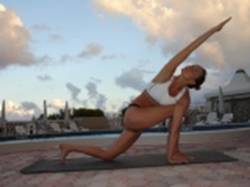 Looking up toward the body (anything overhead including the third eye) has an expansive effect on the body. Looking downward (particularly the nose or navel) keeps the attention inwards and stable.
The most common Drishti is the nose, nasagrai drishti, and it is connected to the root lock, or Mula Bhanda.
The nine traditional points are:
- Nose or nasagrai drishti
- Upwards or urdhva drishti
- Third eye or ajna chakra drishti
- Hand or hastagrai drishti
- Thumbs or angustha madyai drishti
- Right side or parsva drishti
- Navel or nabi drishti
- Foot or padayoragrai drishti
 TIPS
TIPS
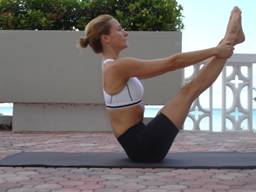
- There is no Drishti given when moving between asanas. Instead, the gaze should be kept low and focused internally.
- During practice, it is not advisable to look around.
- In downward facing dog the drishti is the navel, but if this makes the spine hunch look to the nose instead.
- In most of the forward bends the drishti is the foot, but if this creates too much tension in the neck look to the nose instead.
- If looking at the nose makes you cross-eyed or gives you a headache, maintain
the gaze in the same direction. This will keep your concentration.
Ashtanga Yoga Table of Contents
- What is Ashtanga Yoga?
- Pattabhi Jois
- The Eight Limbs
- Ashtanga yoga mantra
- Ujjayi Breath
- Locks / Bhandas
- Drishti / Gaze
- Vinyasa
- Surya Namaskara / Sun Salutation
- Standing poses
- Padangusthasana
- Padahastasana
- Utthita Trikonasana
- Parivritta Trikonasana
- Utthita Parsvakonasana
- Parivritta Parsvakonasana
- Prasarita Padottanasana A
- Prasarita Padottanasana B
- Prasarita Padottanasana C
- Prasarita Padottanasana D
- Parsvottanasana
- Utthita Hasta Padangusthasana A
- Utthita Hasta Padangusthasana B
- Utthita Hasta Padangusthasana C
- Utthita Hasta Padangusthasana D
- Ardha Baddha Padmottanasana
- Utkatasana
- Virabhadrasana A
- Virabhadrasana B
- Primary Series
- Dandasana
- Paschimottanasana A
- Paschimottanasana B
- Paschimottanasana C
- Purvottanasana
- Ardha Baddha Padma Paschimottanasana
- Trianga Mukhaikapada paschimottanasana
- Janu Sirsasana A
- Janu Sirsasana B
- Janu Sirsasana C
- Marichyasana A
- Marichyasana B
- Marichyasana C
- Marichyasana D
- Navasana (5 times)
- Bhujapidasana
- Kurmasana
- Supta Kurmasana
- Garbha Pindasana
- Kukktasana
- Baddha Konasana A
- Baddha Konasana B
- Upavishta Konasana A
- Upavishta Konasana B
- Supta Konasana
- Supta Padangusthasana A
- Supta Padangusthasana B
- Supta Padangusthasana C
- Ubhaya Padangusthasana
- Urdhva Mukha Paschimottanasana
- Setu Bandhasana
- Intermediate Series
- Finishing Series
- Poster To Go